

Originally published November 10, 2020 at Cinema76.com
Dead Ringers is a film I did not appreciate the first time I watched it, since then it has lived in my head as a lesser-Cronenberg film. However, since I embarked on this deep dive into his work I had a growing suspicion that I would appreciate this much more when it came time to write about it. After seeing a fair amount of his other work, and reading some of his interviews on the film, I knew this would be a fascinating piece to dissect. Dead Ringers is not only a true masterpiece but also one of the most fascinating pieces of Cronenberg’s work I have seen. Those of us who are fascinated by psychology, as well as biological mysteries, are sure to be fascinated by the concept of twins. There are even a large number of other horror films that wade into this territory; De Palma’s Twins, Goodnight Mommy, Twins of Evil, and Blood Rage. Of course, leave it to Cronenberg to create the horrific psychological case study of the tragic Mandel brothers.
Dead Ringers is another one of Cronenberg’s adapted stories, from the book Twins co-written by Bari Wood and Jack Geasland. The interesting part is that the film and the book are both based on true events. Stewart and Cyril Marcus were twin brothers who both worked as gynecologists. They were found dead in their shared apartment in 1975. With little answers to be had from the mysterious and chilling true events, it is no wonder that there were creatives working to fill in the blanks. Similarly to the book, Dead Ringers focuses on the Mantel twins, Beverly and Elliot, who are both played by Jeremey Irons. The brothers are gynecologists who run their own clinic and are essentially inseparable. The two share their home, patients, and their women. Things begin to fall apart for the Mantel boys when Beverly falls in love with Claire, played by Geneviève Bujold. Bev begins to wonder if he can have a part of his own life that he does not share with Elliot. Cronenberg tries to make it difficult at times to tell which brother you are seeing and several of the other actors play more than one role, filling the screen with doppelgangers.
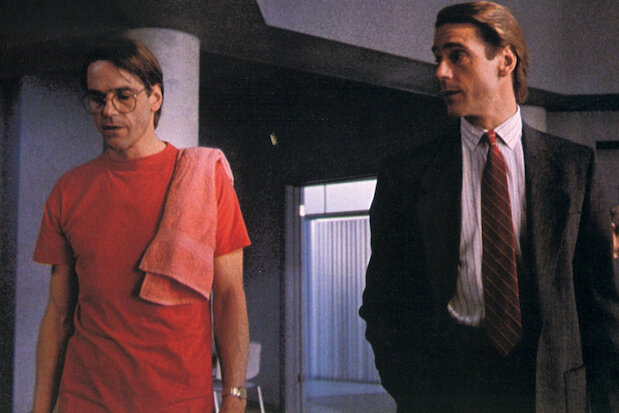
The tagline for the film is “Two Bodies. Two Minds. One Soul.” so it becomes clear what Cronenberg is trying to explore here. What is it to be two halves of a whole? Although it seems to be a romantic notion it also has the darker side of being rife with codependency. The twins do not know how to function without each other. Even when they are not together they give detailed descriptions of their goings-on so that they always feel they are living the same experiences. It becomes more complex in Cronenberg’s story when you realize he is exploring the idea of one twin being entirely masculine and the other feminine. It also has some Freud/Jung theories attached such as the Id and the Superego, both are needed to create the middleground, our ego, where we live. We would not be able to function in just one of these areas. We see Elliot as the extroverted playboy who accepts the awards, makes the speeches, and woo donors into giving their clinic more money. Beverly on the other hand does all of the behind-the-scenes work; doing the research, spending time with the clients, and creating their “State of the art” gynecological tools. As the film goes on they make several references to the Siamese twins “Chang and Eng” drawing to the idea that they are somehow conjoined twins through their connected souls. Bev is stricken by a nightmare of being a conjoined twin with Elliot and Claire tries to free them by biting her way through their connected appendage (one of the few body horror moments of the film).
When Claire enters their lives Beverly falls for her quickly. When she is told by Bev that she has a “trifurcated cervix”, a rare abnormality which also would make it impossible to have children, she is devastated. Elliot ends up having sex with her before Bev, but when Bev goes over there there is an intense sex scene involving rubber tubes and medical clamps that makes the scene feel rather clinical . Elliot asks for all of the details and Bev tells him he wants to keep this one for himself. Ellie responds that “You haven’t had any experience until I’ve had it.” This throws the first wrench into the shared life the two have created together. Claire eventually finds out that she has been having sex with both the brothers; she can see the warmth in Bev and the disinterest in Elliot. She confronts the brothers and tells them off, while Elliot would be more than happy for him and Bev to move on from this woman it is clear that nothing will ever be the same for Bev. Ellie sees that she has become a problem for the two brothers and tries to convince Bev they should not see her anymore, Elliot tells Bev “She’s a flake…you never really know who she is” one of the funniest lines in the film considering the premise.

Bev manages to patch things up with Claire and the two start seeing each other, and only each other. Given Bev’s codependency issues this changes him quite a bit, since Claire takes a lot of different pills and drugs he starts doing them with her. Claire also seems to start going through her own transformation. Hearing that she cannot have children she says she feels less like a woman. Through her actions and wardrobe we begin to get the idea that she is going through a gender identity crisis. As they spend more time together Claire dresses more and more masculine, which also makes her a surrogate Elliot for Bev. Bev becomes emotionally dependent on her. There is one scene when Claire leaves to film a movie and Bev is wearing a small bathrobe begging her not to go, making her look like the “Stronger” more masculine one, while he is framed in the doorway as the more “emotional” and “feminine” in the relationship. It is not the only time the film gives off the impression that Bev is made to take on these 1950s conventional “housewife” kind of roles. He becomes convinced that she is cheating on him when she is gone and falls into despair, with only Elliot to turn to.
Recently, Miskatonic Institute of Horror Studies offered a class taught by Dr. Laura Westengard on Queer Gothic Horror. Watching this film right after taking this class made me look at it in an entirely new light. I found so many gothic themes and elements to this film that I haven’t necessarily noticed in Cronenberg’s other work. One element that I noticed were the incestual implications, and because they are brothers the film has some queer themes as well. The brother’s sharing of sexual partners seems to be a way for them to be with each other without actually being with each other. As the film progresses it becomes more obvious that sex is an essential part of their relationship, even if they never actually sleep with each other. The two feel like siblings but also very much feel like a dysfunctional couple. When Bev decides to have Claire for himself, Elliot retaliates and takes a teaching position for himself. Elliot simply tells Bev he can take care of the clinic on his own, the scene feeling like a husband telling his wife that she can take on more work at the house while he goes to the office.

Both of the men are confronted with their sexuality in different ways. Bev becomes self-conscious of his girlish name and in front of Claire lashes out assuming she is accusing him of being gay. Without the Elliot parts he feels like less of a man. When Bev begins to see Claire it also affects Elliot’s sexual performance. In one scene he hires twin sex workers and tells one to call him Elliot and the other to call him Beverly, clearly still trying to find a way to make his brother a part of his sex play. As things get more serious between Bev and Claire she tries to become friends with Elliot and he tells her that she presents “a confusing element to the Mantel Brother saga, possibly a destructive one.” He attempts to kiss her and tells her the only way the three of them could function is if they were all together but Claire quickly refuses. It is also clear it enrages Elliot to think that someone would prefer sweet Bev to him. Eventually, Elliot does try to get Bev to have a threesome with a woman he is seeing but Bev is too far gone and in love with Claire to go through with it. In the same scene Bev collapses in the apartment and Elliot’s date tries to give him mouth to mouth. Elliot shoves her so hard she hits a wall. The idea of this woman saving his brother and not him is too much for him to handle.
What is palpable throughout the film is their misogyny and total misunderstanding of women. They graduated from the school of gynecology with most other white men and even as children decided that women were “so different from us.” They even make fun of their patients for their desperation in wanting a child, when in reality, they are two grown men that cannot function without the other. It seems that they look down on women, but also their livelihood and sexual relationships are based around women. It is even more interesting when you find out that the brothers will not work with men at their clinic, even in order to help couples conceive. For the Mantel boys no matter how much they study the female anatomy or how frequently they bed women they seem to have no idea what to think about them. It’s a wonder why any of these women would even want to go to these doctors but, their understanding of the female anatomy does somehow make them more accessible than typical men. There is a great scene early in the film with Elliot and Claire, who are having dinner with someone she works with. Claire brings up the results of her appointment. Elliot has no problem talking about her period and other intimate findings, but the man at the table with them can’t stomach the conversation and leaves. It seems that the bar is set so low for guys that just being able to talk about a woman’s body without getting grossed out is an attractive quality.
Throughout Cronenberg’s filmography, I have found his female characters to be some of the most interesting and complex characters and I have often wondered if Cronenberg is trying to understand women through these characters he puts on screen. Dead Ringers is no exception. Although Claire’s main function in the film is of the wrench that ruins their perfect machine of a life, she is fascinating. Claire does mirror many of Beverley’s issues; abandonment, drug abuse, sexual hang-ups, she is ultimately one thing Bev will never be, independent. She can hold her life together without needing someone else. As Bev’s codependency grows it is clear that she is with him because she wants to be, and he is with her because he needs her, or at least someone. She leaves him to shoot her film without even thinking about the fact that he would not be able to keep himself together. Her world does not revolve around him therefore she assumes he would be fine, little does she know Bev is becoming totally unhinged without her.
Bev, under the impression that Claire is cheating on him because her male assistant answers her phone, takes his unfounded grief and heartbreak and turns it into more of a hatred towards women. In one scene Bev is trying to use one of his gynecological tools on a patient who tells him that the tool is hurting her. He lashes out at her telling her that the tool is not the problem it is her. Throughout history, women have had issues with doctors listening to them and their medical concerns. All too often doctors assume women have mental health issues as opposed to real physical issues. This moment stands out as a clear commentary on the overarching misogyny in medical care. It is the woman that is the problem and not the tools or treatment they are using on her. Too often things like this happen to women looking for treatment and it stings to watch this scene if you have ever been in that position. It is clear that Bev cannot even work with the women in his clinic anymore.
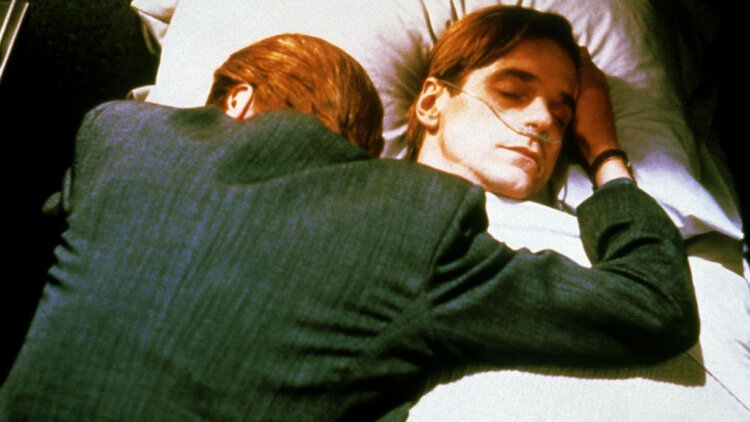
Bev becomes more hateful and deranged and by the end, he goes to have specially designed tools that are for “mutant women”. He becomes convinced that something is going wrong in the world and it is affecting the women they see in the clinic. The tools he has created look like medieval torture devices. After attempting to use these devices in surgery he almost kills the woman he is operating on. Elliot becomes convinced that the only way for him to save Bev is for them to get “synchronized”. He starts taking drugs with Beverley and they convince themselves they will quit together. They dress the same, eat the same things, and neglect everything else in the outside world. In the climax of the film, Bev uses medieval instruments to somehow disconnect himself from Elliot but he is in such a drug-induced state he wakes up and is in complete denial of his brother being dead. Instead Bev gets ready for his day and makes an attempt to live as both Bev and Elliot. He thinks that he can somehow hold the two personalities together in one body. He walks out of their apartment and goes to call Claire but instead goes back inside and dies on top of Elliot.
The tragedy of these two men, who are so connected that anyone else coming into their world destroys their lives is poignant. For the issues these two men have, and the hateful things they had done to women you cannot help but feel sorry for them. In the end they are just little boys who have been playing adults. Even the disarray of their apartment at the end looks like there are no adults to clean up after them. Although the brothers seem to hold either masculine or feminine qualities, in the end, they are both men. And they both exhibit their toxic behavior in different ways. Although Bev comes off as sweet and Elliot seems like “Dracula” as Claire says, they both still have major issues with their manhood which becomes more problematic as they are “separated”. Although Elliot boasts early in the film that pain is unnecessary it is obvious the tremendous pain they both feel as their relationship becomes more complicated.

In concluding it felt important to acknowledge Denise Cronenberg, sister to David and costume designer for many of his films. The costumes are so important and striking for the characters especially with the overarching themes of gender in the film. She also creates the blood-red medical gowns that the brothers wear in the operating room. The outfit makes the brothers look like they are priests or cult leaders who control this world full of women because they have the ability to fix their bodies. Although there are not that many scenes with them in this costume, it is an unforgettable image that says so much about the film’s major themes. Denise was also nominated for several awards for her costume design and some specifically for this film. She died early this year and it is a great loss for the film community. I love that Denise worked on so many of her brother’s films. She helped to bring to life the vision to these fascinating stories on gender, sex, and horror.
As far as gender and sex themes this film i has so many different layers. It is even more impressive when two of the leads are played by the same actor. Jeremy Irons is fantastic as the two brothers and the fact that you begin to know which is which after a while speaks a lot to the performance. It makes the film even more since Irons has had issues in the past, making comments about how “gay marriage could lead to same-sex incest” in 2013. Although he backtracked on these problematic views, its fascinating to think of him taking on these complicated characters with such a warped perspective. I do find that Cronenberg seems to cast these very complicated male leads and I often wonder how much of that is intentional, especially since so much of his work seems to intentionally bring up issues around misogyny. The body horror that is in this film is also light but used so effectively in the nightmare sequence with the conjoined twins. Having the added background of the tragic real-life tale in the film also adds a whole other level to the atmosphere of the film. I would say this pairs well with The Fly in the sort of tragic romanticism of it, even if it’s the story of brothers. Cronenberg’s issues with psychology and medicine which have been seen in other films is very potent here and should be interesting in some of the films to come. There is a TV adaptation in the works for this film that is meant to star Rachel Weisz as the twins which is sure to be another fascinating exploration of these themes.
 The Neon Banshee