

Originally published September 10, 2020 at Cinema76.com
Recently my partner and I decided to sit down and watch The Dead Zone, another Cronenberg that we often overlook. I was excited to see it but knew from interviews with Cronenberg that it was probably one that I would not end up writing about for my series. And it turns out I was right on that front. He made Dead Zone right after the failed reception of Videodrome and he took that failure to heart. Compared to much of Cronenberg’s work you can feel how sexually repressed this one is. In an early scene, Johnny Smith (Christopher Walken) won’t even kiss his fiancee in the hallway and there’s not a sex scene to be had throughout the whole thing. Although it’s an enjoyable film, you can feel that Cronenberg did not find much to sink his teeth into when he adapted this Stephen King novel. A major difference from films like The Fly, so I was excited to look at another of the films Cronenberg directed that was adapted from the J.G. Ballard novel, Crash.
Crash debuted in the fall of 1996. It stars James Spader as James Ballard, a film producer who is in an open relationship with his wife Catherine (Deborah Kara Unger). The couple typically engages in sexual trysts with random people they encounter, and then describe the events to each other later on. Ballard gets into a car crash that results in the death of the other driver. While recovering in the hospital he meets Dr. Helen Remmington (Holly Hunter), the other passenger in the car. Eventually, the two begin having an affair. They bond over their shared traumatic experience and she brings Ballard into a world of similar-minded individuals who get off on car crashes. The world opens up for him and his wife as they delve deeper into this new kink and become close with its leader, Vaughan (Elias Koteas).
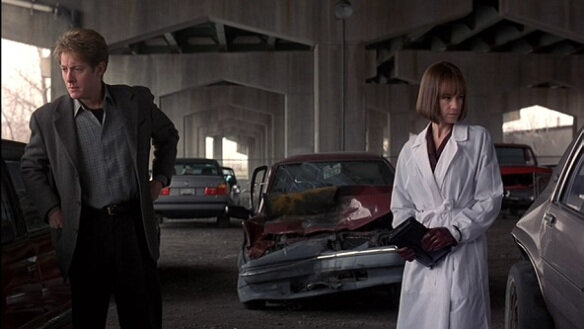
Crash might be the opposite of The Dead Zone in regards to its sexuality. For the purposes of this piece, I watched the NC-17 version (because if we are going to talk sex lets really get into it). Crash also offers a stark difference to The Fly which is probably the most romantic and warm of Cronenberg’s filmography. With all its hot sex scenes, Crash is one of the coldest films I have ever seen. There is little optimism, hope, or love that can be found in the world this film creates. Although I have not read J.G. Ballard’s novel, based on what I have read about the film and the two creatives working together I have gathered they are similar in this regard. This is another fascinating example of what happens when Cronenberg melds with the right source material, and although it does not have the level of body horror one might think of when they think on Cronenberg’s work you can feel that same DNA running through this story.
Both the book and film have a solid reputation for being vulgar and over the top. Not only does it open and close with an explicit sex scene it has multiple peppered throughout. The combination of sex, cars, and death is not dissimilar to the themes we see in many of Cronenberg’s films. The characters in this world have “evolved” past regular sexual intercourse and heteronormative relationships. However, these people cannot simply live on the fringes of society they have to give their habit a meaning, a religion. As Vaughan says to Ballard “The car crash is a fertilizing rather than a destructive event, a liberation of sexual energy.” It would be easy to write Vaughan off as some crazy prophet but it seems easier for Ballard to accept this man, in order to accept himself and his newfound pleasure.
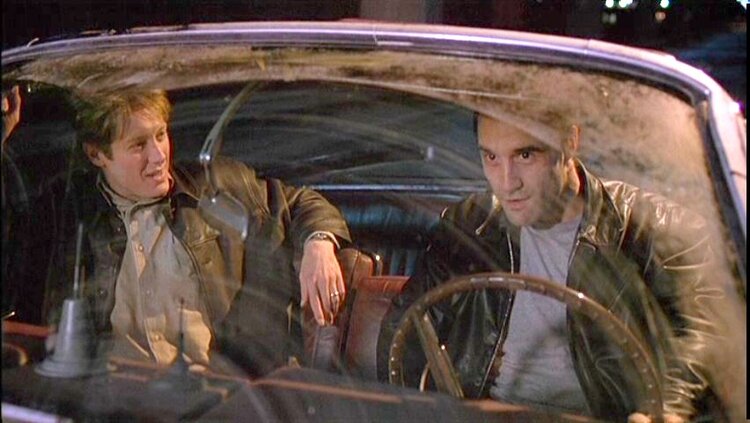
When Ballard first meets Vaughan he is staging the famous car crash of James Dean with the help of some stunt drivers. The crowd is full of spectators taking in Vaughan’s words as he describes and then acts out the historic crash. This quickly turns Ballard from voyeur to an active participant as he becomes involved in crashes with Vaughan. Everyone has sex in cars until that act alone is not enough to excite them. As their hunger grows it becomes obvious that the near misses and scars are not enough, they even get sexual gratification from the resulting deaths of the accidents. Vaughan is accused of running over a pedestrian and Ballard gets almost jealous stating that he’s “not interested in pedestrians, but then later finds the blood on Vaughan’s car. They even stop and interact with people who have just gotten into an accident. When Vaughan sees that one of the victims lying dead in front of him is his stunt partner the ecstasy on his face cannot be hidden. It turns death into an odd sexual liberation and celebration.
Cronenberg manages to find the perfect cast to populate this erotic thriller. It is easy to see how someone like James Spader would be able to latch onto the source material and bring life to Ballard. Although the writer names the main character of the novel after himself Spader does feel like another evil twin of Cronenberg (much like James Woods in Videodrome). Especially seeing this film after seeing his appearance in The Office where he has quotes like “there is only sex”, he was born to play this role. Ballard is such a fascinating character too, it seems fated that he would find this group of car enthusiasts. When he gets into an accident he is looking over a script for the movie he is working on and not paying any attention to the road. After his accident, he seems somewhat traumatized and even has trouble performing for his wife. As opposed to finding healthy ways of dealing with the trauma he instead goes the complete other direction and finds something to elevate his sexual desires. It’s hard to say if that is supposed to be some comment on masculinity but I find myself fascinated by that detail.
Then we have his counterpart Vaughan, a man that everyone seems to be terrified of and attracted to at the same time. With all of their sexual freedom, it ends up taking the two quite sometime before they actually have sex, and then they immediately try to kill each other after the fact. Even though they think themselves rather evolved in their sexual exploits they still have the most trouble being with each other. Vaughan’s charisma and confidence make him a perfect cult leader. He remarks on how he wants to be in one of these cars that were part of an accident like there would be residual energy that he could get off on. Ballard and his wife talk about and get off on the fantasy of his potentially gnarled and disfigured penis. Vaughan however, still seems to exhibit common insecurities. When getting a tattoo with Ballard, he tells the artist that its a “prophetic tattoo so it has to be “ragged and dirty”, caring so much about how the tattoo will fit in with his aesthetic. There is also a scene where Vaughan picks up a sex worker while with James while talking to her he tells her to “spit out your gum. I don’t want it going up my urethra.” Vaughan can’t possibly stomach the idea of dying some way besides being in a car.
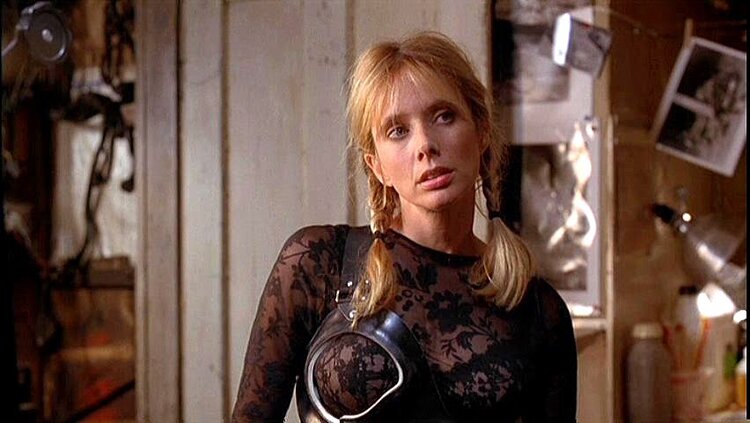
Much like Cronenberg’s other films the female characters living in this world seem to be the more interesting and complex. Catherine Ballard is entrancing in her cold demeanor, barely even showing excitement while achieving sexual gratification. Often times it is hard to tell what she must be thinking. Then there is Dr. Remington (with Holly Hunter giving one of her most interesting performances) who seems to be addicted to the crashes. While the group is watching car crash videos their video freezes and Remington loses her cool demeanor and falls all over herself trying to find the remote to see the collision. Finally, there is Gabrielle (Rosanna Arquette) who seems to be the only female lead to have a bit of warmth and tenderness in her performance. Despite the fact that she has had major damage to her legs resulting in large scars down the back of her legs, she is still as engaged in the excitement as the rest of the group. It is obvious the represent even more when Ballard has sex with her and enters through one of the wounds. The crashes and resulting scars manage to give them totally new ways of having sex. Most importantly the film goes out of its way to show depictions of female pleasure and gratification, something that is sometimes still too uncommon in our media.

The film brings up similar themes to Cronenberg’s films like Videodrome and The Fly, all riddled with obsessions over our need for sex, technology, and transformation. These characters need to believe that they have tapped into something futuristic, which makes them somewhat about the rest of society that has not quite figured it out yet. Ballard and Catherine would much rather enter this world of sex and death than admit trauma or go seek psychiatric help. Similar to Dr. Brundle in The Fly it is much more simple to admit the world needs to change than to admit you do. Vaughan cannot just be a sociopath, killer, and cult leader, he has to be a prophet. Similar to Videodrome there is the idea of how dangerous these things become when people give it a belief system. By the end of the film, it becomes clear that the Ballard’s are now consumed by this new belief. When it comes to gender it feels that the characters in the film have transcended carrying about such things all that matters is the pleasures and pain they can get from these crashes.
The end of the film is so impactful in this regard as well. After Vaughn dies, Ballard takes his car and starts chasing Catherine in it. James runs Catherine off the road and when he goes to see the wreckage she tells him she is fine, with a hint of disappointment on her dazed face. James tries to comfort her by telling her that “Maybe the next one”, referring to the idea that maybe the next one will be the one that kills her and helps her transcend like the others. It echoes a conversation the two have at the beginning of the film when Catherine asks if he made the “camera girl cum” when he says no she tells him “maybe the next time” Now the couple has begun to equate sexual gratification with sex. I don’t know if what the Ballard’s have would be called love but at the least, they have found someone that can handle the same kind of dysfunction and I suppose there is something romantic in that.
In an interview with Cronenberg, he says that “the film’s all about dealing with mortality. I always do this in my films, it’s a rehearsal for my own death to see what my characters do with theirs. They’ve eroticized death, and that’s their triumph. It’s a good trick to pull off if you can do it.” None of us can escape death so we find solace in what we can. The characters in the world of Crash found another way to deal with it. And as insane as it may seem maybe there is some seed of healthy coping within that. I find most organized religions up there so I do not know if what they have done is all too different, and I think Cronenberg might agree with that one.
With so many other Cronenberg’s to delve into I am excited to see how his others fit in with the likes of Crash.
 The Neon Banshee